PROJECT ASHABI
African Stories. Limitless Worlds.
PROJECT ASHABI
African Stories. Limitless Worlds.
Project Gutenberg Archive
Complete unabridged public-domain literary work from the Project Gutenberg archive.
Project Ashabi is being built as the home of original African comics, webtoons, graphic novels, and fiction.
This third-party Novel / Book title is temporary preview content. Step by step, third-party titles will be phased out and replaced exclusively by Ashabi Originals created by African writers and artists.
Produced by Curtis A. Weyant, Charles Franks and the Online Distributed Proofreading Team.
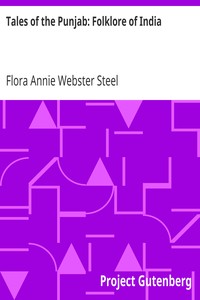
TALES OF THE PUNJAB FOLKLORE OF INDIA
Sir Buzz The Rat's Wedding The Faithful Prince The Bear's Bad Bargain Prince Lionheart and his Three Friends The Lambkin Bopolûchî Princess Aubergine Valiant Vicky, the Brave Weaver The Son of Seven Mothers The Sparrow and the Crow The Tiger, the Brâhman, and the Jackal The King of the Crocodiles Little Anklebone The Close Alliance The Two Brothers The Jackal and the Iguana The Death and Burial of Poor Hen-Sparrow Princess Pepperina Peasie and Beansir The Jackal and the Partridge The Snake-woman and King Ali Mardan The Wonderful Ring The Jackal and the Pea-hen The Grain of Corn The Farmer and the Money-lender The Lord of Death The Wrestlers The Legend of Gwâshbrâri, the Glacier-Hearted Queen The Barber's Clever Wife The Jackal and the Crocodile How Raja Rasâlu Was Born How Raja Rasâlu Went Out Into the World How Raja Rasâlu's Friends Forsook Him How Raja Rasâlu Killed the Giants How Raja Rasâlu Became a Jôgi How Raja Rasâlu Journeyed to the City of King Sarkap How Raja Rasâlu Swung the Seventy Fair Maidens, Daughters of the King How Raja Rasâlu Played Chaupur with King Sarkap The King Who Was Fried Prince Half-a-Son The Mother and Daughter Who Worshipped the Sun The Ruby Prince
Many of the tales in this collection appeared either in the _Indian Antiquary_, the _Calcutta Review_, or the _Legends of the Punjab_. They were then in the form of literal translations, in many cases uncouth or even unpresentable to ears polite, in all scarcely intelligible to the untravelled English reader; for it must be remembered that, with the exception of the Adventures of Raja Rasâlu, all these stories are strictly folk-tales passing current among a people who can neither read nor write, and whose diction is full of colloquialisms, and, if we choose to call them so, vulgarisms. It would be manifestly unfair, for instance, to compare the literary standard of such tales with that of the _Arabian Nights_, the _Tales of a Parrot_, or similar works. The manner in which these stories were collected is in itself sufficient to show how misleading it would be, if, with the intention of giving the conventional Eastern flavour to the text, it were to be manipulated into a flowery dignity; and as a description of the procedure will serve the double purpose of credential and excuse, the authors give it,--premising that all the stories but three have been collected by Mrs. F. A. Steel during winter tours through the various districts of which her husband has been Chief Magistrate.
A carpet is spread under a tree in the vicinity of the spot which the Magistrate has chosen for his _darbâr_, but far enough away from bureaucracy to let the village idlers approach it should they feel so inclined. In a very few minutes, as a rule, some of them begin to edge up to it, and as they are generally small boys, they commence nudging each other, whispering, and sniggering. The fancied approach of a _chuprâsî_, the 'corrupt lictor' of India, who attends at every _darbâr_, will however cause a sudden stampede; but after a time these become less and less frequent, the wild beasts, as it were, becoming tamer. By and by a group of women stop to gaze, and then the question 'What do you want?' invariably brings the answer 'To see your honour' (_âp ke darshan âe_). Once the ice is broken, the only difficulties are, first, to understand your visitors, and secondly, to get them to go away. When the general conversation is fairly started, inquiries are made by degrees as to how many witches there are in the village, or what cures they know for fever and the evil eye, _etc_. At first these are met by denials expressed in set terms, but a little patient talk will generally lead to some remarks which point the villagers' minds in the direction required, till at last, after many persuasions, some child begins a story, others correct the details, emulation conquers shyness, and finally the story-teller is brought to the front with acclamations: for there is always a story-teller _par excellence_ in every village--generally a boy.
Then comes the need for patience, since in all probability the first story is one you have heard a hundred times, or else some pointless and disconnected jumble. At the conclusion of either, however, the teller must be profusely complimented, in the hopes of eliciting something more valuable. But it is possible to waste many hours, and in the end find yourself possessed of nothing save some feeble variant of a well-known legend, or, what is worse, a compilation of oddments which have lingered in a faulty memory from half a dozen distinct stories. After a time, however, the attentive collector is rewarded by finding that a coherent whole is growing up in his or her mind out of the shreds and patches heard here and there, and it is delight indeed when your own dim suspicion that this part of the puzzle fits into that is confirmed by finding the two incidents preserved side by side in the mouth of some perfectly unconscious witness. Some of the tales in this volume have thus been a year or more on the stocks before they had been heard sufficiently often to make their form conclusive.
And this accounts for what may be called the greater literary sequence of these tales over those to be found in many similar collections. They have been selected carefully with the object of securing a good story in what appears to be its best form; but they have not been doctored in any way, not even in the language. That is neither a transliteration--which would have needed a whole dictionary to be intelligible--nor a version orientalised to suit English tastes. It is an attempt to translate one colloquialism by another, and thus to preserve the aroma of rough ready wit existing side by side with that perfume of pure poesy which every now and again contrasts so strangely with the other. Nothing would have been easier than to alter the style; but to do so would, in the collector's opinion, have robbed the stories of all human value.
That such has been the deliberate choice may be seen at a glance through the only story which has a different origin. The Adventures of Raja Rasâlu was translated from the rough manuscript of a village accountant; and, being current in a more or less classical form, it approaches more nearly to the conventional standards of an Indian tale.

Arthur Conan Doyle