PROJECT ASHABI
African Stories. Limitless Worlds.
PROJECT ASHABI
African Stories. Limitless Worlds.
Project Gutenberg Archive
Complete unabridged public-domain literary work from the Project Gutenberg archive.
Project Ashabi is being built as the home of original African comics, webtoons, graphic novels, and fiction.
This third-party Novel / Book title is temporary preview content. Step by step, third-party titles will be phased out and replaced exclusively by Ashabi Originals created by African writers and artists.
This etext was produced by John Mamoun <mamounjo@umdnj.edu> with the online distributed proofreaders team of Charles Franks
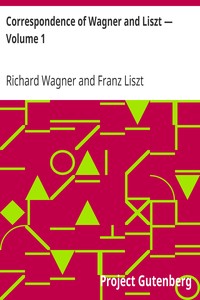
Correspondence of Wagner and Liszt, Volume 1 (1889)
By Richard Wagner; Franz Liszt; Francis Hueffer (translator)
BRIEF BIOGRAPHICAL SKETCH TRANSLATOR'S PREFACE CORRESPONDENCE OF WAGNER AND LISZT, Volume 1 INFO ABOUT THIS E-TEXT EDITION
The German musical genius Richard Wagner (1811-1883) could be considered to be one of the ideological fathers of early 20th century German nationalism. He was well-suited for this role. Highly intelligent, sophisticated, complex, capable of imagining whole systems of humanistic philosophy, and with an intense need to communicate his ideas, he created great operas which, in addition to their artistic merits, served the peculiar role of promoting a jingoistic, chauvenistic kind of Germanism. There are things in his operas that only a German can fully understand, especially if he would like to see his country closed off to outsiders. It is unlikely, however, that Wagner expected these ideas to achieve any popularity. Time and again he rails against philistines, irrational people and politicians in his letters. With great exasperation and often depression he expressed little hope that his country would ever emerge out of its "philistinism" and embrace "rational" ideas such as he propagated. Add to this the great difficulties he had in getting his works performed, and one might assume that he felt himself to be composing, most of the time, to audiences of bricks. Yes, his great, intensely beloved friend Liszt believed in, fully understood, and greatly appreciated Wagner's works, but Liszt was just one in a million, and even he, as Wagner suggested, associated with a base coterie incapable of assimilating Wagnerian messages. Considering the sorry state of music and intellectualism in Wagner's time and setting, he surely would have been surprised if his operas and his ideas achieved any wide currency. That he continued to work with intense energy to develop his ideas, to fix them into musical form and to propagate them, while knowing that probably no sizeable population would ever likely take note of them, and while believing that his existence as an underappreciated, rational individual in an irrational world was absurd and futile, is a testimony to the enormous will-power of this "ubermensch."
The best introduction to this important correspondence of the two great musicians will be found in the following extract from an autobiographical sketch written by Wagner in 1851. It has been frequently quoted, but cannot be quoted too often, describing, as it does, the beginning and the development of a friendship which is unique in the history of art.
"Again I was thoroughly disheartened from undertaking any new artistic scheme. Only recently I had had proofs of the impossibility of making my art intelligible to the public, and all this deterred me from beginning new dramatic works. Indeed, I thought everything was at an end with my artistic creativeness. From this state of mental dejection I was raised by a friend. By the most evident and undeniable proofs he made me feel that I was not deserted, but, on the contrary, understood deeply by those even who were otherwise most distant from me; in this way he gave me back my full artistic confidence.
"This wonderful friend has been to me Franz Liszt. I must enter a little more deeply into the character of this friendship, which, to many, has seemed paradoxical.

Arthur Conan Doyle